Continuous Modernization and Best Practices for Your PeopleSoft Applications
-
Posted by Quest Editor
- Last updated 12/08/25
- Share
Continuous Modernization and Best Practices for Your PeopleSoft Applications
A RECONNECT Session with SmartERP, now part of Mythics
When you’ve invested decades in PeopleSoft, “do nothing” isn’t really an option. Tax updates evolve, tools releases keep rolling, seasoned talent is retiring, and cloud options continue expanding. In this RECONNECT Spotlight Session, Doris Wong of SmartERP—now part of Mythics, alongside SpearMC—offers a clear, practical roadmap for continuous modernization of PeopleSoft applications. The focus: maximizing PeopleSoft today while preparing strategically for tomorrow, without rushing to Fusion Cloud.
Meet SmartERP, Mythics and SpearMC: One PeopleSoft Powerhouse
Wong begins by grounding the session in experience. With 30+ years in enterprise applications and 25+ years working with PeopleSoft, including serving as Group VP and General Manager over the PeopleSoft product line after Oracle’s acquisition, she brings a unique vantage point. For the past 16 years, her work at SmartERP has centered on helping PeopleSoft customers modernize, enhance, and sustain their systems.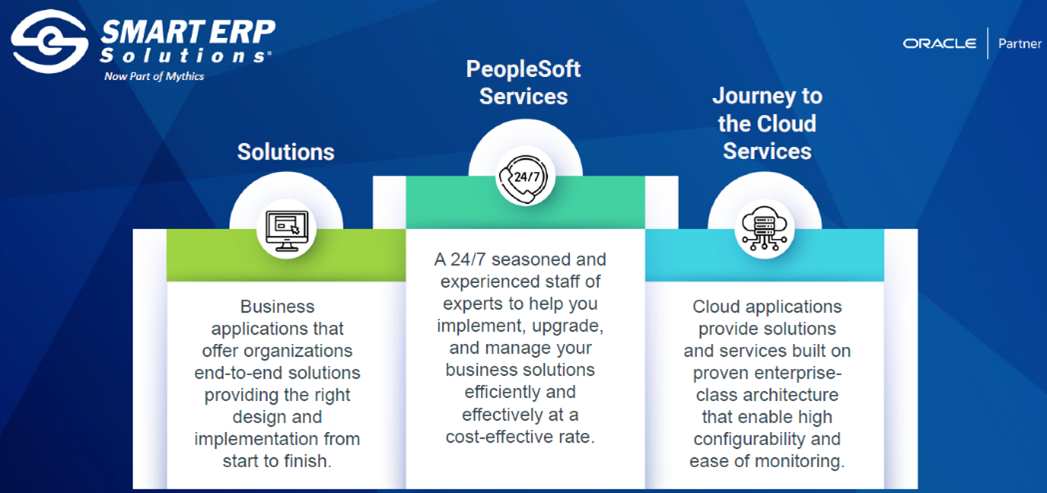
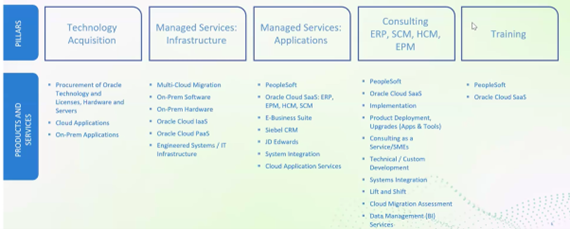
SmartERP has long been known for full lifecycle PeopleSoft services—upgrades, implementations, custom
development, BI, integrations, and data management— along with a suite of add-on solutions designed to simplify, streamline, and automate business processes. Many of these solutions now exist as modern cloud offerings.
Recently, SmartERP joined forces with Mythics, a major Oracle partner, and SpearMC, a PeopleSoft consulting and training provider. Together, they operate as one PeopleSoft powerhouse offering:
- Full lifecycle PeopleSoft projects and optimization
- Managed services for infrastructure and applications
- Cloud migrations and hybrid architectures
- Training, enablement, and Guided Learning solutions
SmartERP alone brings more than 350 clients, 400+ employees, and a “client for life” approach. Combined with Mythics and SpearMC, customers gain expanded capabilities across healthcare, higher education, public sector, financial services, and more.
Part 1: Process – Modernizing and Maximizing Your Current PeopleSoft Investment
The first pillar of modernization is process—how you manage releases, tools, tax compliance, and delivered features to keep PeopleSoft healthy and evolving.
If You’re Still on 9.0 or 9.1
Many organizations remain on earlier releases because they feel “stable enough,” but Wong stresses that this is not a long-term strategy—especially for payroll customers.
She highlights three key options:
- Upgrade PeopleTools even if applications don’t move
Staying current on PeopleTools helps maintain security, patch compatibility, and access to newer technical features—all without a full apps upgrade. - Stay current with tax updates
For payroll customers, tax updates are essential. Wong notes that 1 tax updates extend into late 2026, giving organizations a clear window to plan their next steps. - Keep the path open to 9.2
Organizations that aren’t ready yet still keep the door open. SmartERP continues to help many customers move from 9.0/9.1 to 9.2 when timing aligns.
If You’re on PeopleSoft 9.2
Most RECONNECT attendees fall here. With Oracle’s rolling 10-year support policy extending through 2036, 9.2 customers have runway to modernize strategically.
Wong emphasizes that staying current requires intentionality: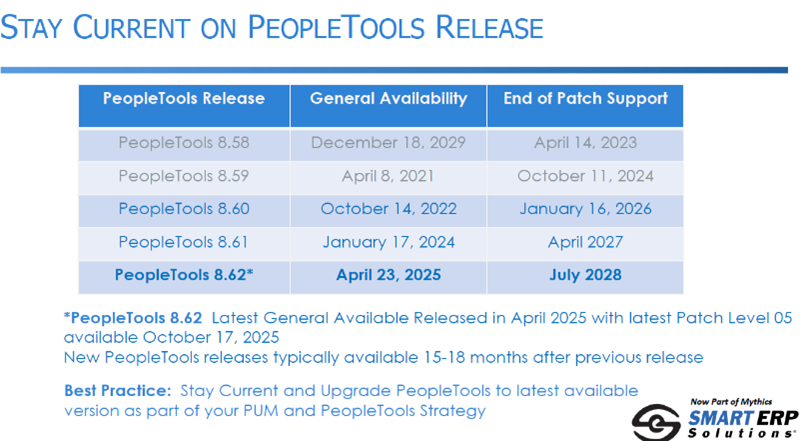
- Define a PUM Strategy
Selective adoption doesn’t work without a cadence. Some organizations alternate HCM and Financials each year; others keep both pillars current annually. The goal is a sustainable rhythm, not quarterly perfection. - Maintain Current PeopleTools Versions
PeopleTools underpins everything, and older releases fall out of patch support. Wong stresses aligning PeopleTools upgrades with PUM cycles and always adopting the latest patch level available. - Use the Cumulative Feature Overview (CFO) Tool
The CFO, available through the PeopleSoft Information Portal, helps customers compare current and target PUM levels. It highlights new features, compliance updates, bug fixes, minimum PeopleTools requirements, and video feature overviews. SmartERP uses it extensively to build value-based upgrade plans and business cases. - Leverage the PeopleSoft Information Portal
The portal provides roadmaps, schedules, planning tools, legislative updates, and more—resources SmartERP incorporates into every modernization roadmap.
Customer Story: SickKids – PUM Upgrade and Mobile Inventory
To bring all of that process discussion to life, Wong shares SickKids, a major Canadian hospital.
Challenges:
- Limited internal staff
- PeopleSoft had not been updated since the original upgrade
- Outdated or insufficient third-party inventory system
- Need to improve efficiency in inventory management and mobile workflows
SmartERP’s approach:
- Ran a CFO analysis to identify the most impactful new features
- Performed a PUM upgrade to bring SickKids to a current image
- Implemented PeopleSoft Mobile Inventory
- Helped redesign their supply chain processes around the new capabilities
Outcomes:
- SickKids now runs on the latest PeopleSoft release
- Inventory processes are more efficient, mobile-friendly and maintainable
- The hospital is better positioned to keep up with future PUM images and enhancements
This is a classic example of modernizing in place—protecting and extending an existing PeopleSoft investment with targeted upgrades and Oracle-delivered features.
Part 2: People – Protecting and Extending Your PeopleSoft Talent
The second pillar Wong addresses is people. Having the right strategy doesn’t matter if you don’t have the right skills and capacity to execute.
The PeopleSoft Talent Challenge
Organizations face four converging issues:
- Retirement of long-time experts with deep institutional knowledge
- Difficulty recruiting experienced PeopleSoft professionals
- Limited pipeline of younger technologists gravitating to legacy ERP
- Increasing business demand for modern UX, analytics, and automation
This raises critical questions about staffing PeopleSoft: Do you have the PS admins, developers, analysts, and system experts needed to stay current? And if not, how do you avoid burning out existing staff?
SmartERP, Mythics, and SpearMC as an Extension of Your Team
Wong explains two parallel strategies: develop internal talent and extend your team with specialized partners. The latter is where SmartERP’s combined organization offers considerable value.
They provide:
- Functional and technical managed services
- Production support
- Custom development and integrations
- PUM and PeopleTools upgrades
- Project-based consulting
- Additional surge capacity during major initiatives
This blended support model helps organizations stay current without overextending limited internal teams.
Customer Story: Managed Services for a Global Manufacturer
Cone, a supply chain manufacturer, faced turnover and lacked resources for ongoing maintenance and project work. SmartERP delivered comprehensive managed services—functional, technical, and operational—while also supporting integration work after an acquisition. This allowed Cone’s internal team to focus on strategic tasks while SmartERP kept PeopleSoft running smoothly.
Part 3: Continuous Modernization – Hybrid Cloud Strategies for PeopleSoft
The third pillar focuses on modernization through cloud adoption, but not in an all-or-nothing way. Wong outlines several hybrid models that keep PeopleSoft at the core while integrating cloud capabilities around it.
Strategy 1: Lift and Shift PeopleSoft to the Cloud
Many organizations retain PeopleSoft as their system of record but migrate infrastructure to OCI, AWS, or Azure. Lift-and-shift reduces reliance on on-premise hardware and gives organizations more flexibility and scale.
SmartERP’s methodology includes:
- Assessment & Planning
- Design
- Migration
- Validation & Testing
- Cutover
- Optimize & Stabilize
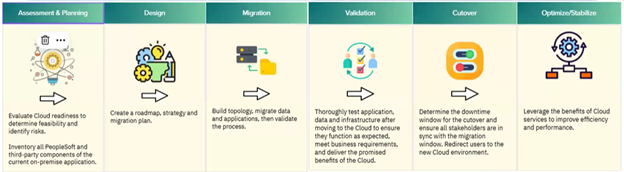
SmartERP can handle the full lifecycle or collaborate with your internal IT and infrastructure teams.
Customer Story: Healthcare Organization Moves PeopleSoft to the Cloud
A health management system, HMS provides a real-world example. HMS ran PeopleSoft entirely on-premise but struggled with the resources required to maintain infrastructure and support. SmartERP helped them lift and shift PeopleSoft to Microsoft Azure (a similar pattern would apply to OCI), then took on ongoing production support and operations. With SmartERP managing uptime, tickets, demo instances and round-the-clock coverage, HMS was able to redeploy internal staff to higher-value work while still benefiting from a modern, cloud-hosted PeopleSoft environment.
Strategy 2: Move PeopleSoft to OCI and Use PeopleSoft Cloud Manager
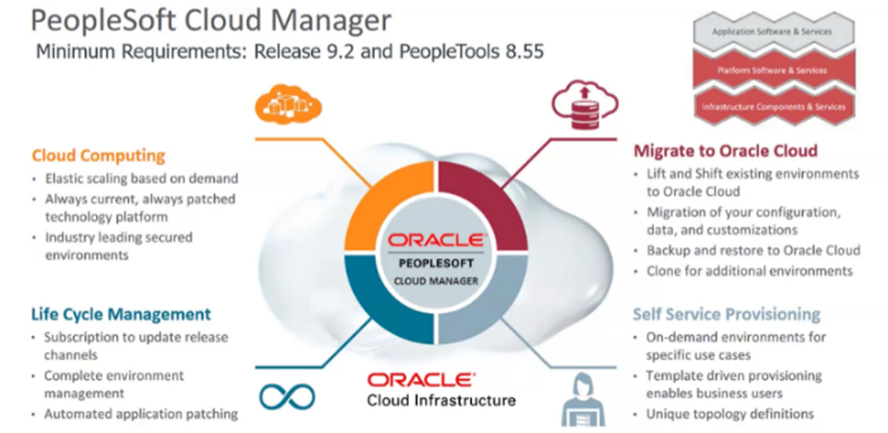
Customers who migrate to OCI gain access to PeopleSoft Cloud Manager, which automates:
- Environment provisioning
- PUM and PeopleTools patching
- Cloning and refreshes
- Scaling policies and cost optimization
PCM dramatically reduces provisioning time—from days to hours or even minutes—and provides long-term operational efficiencies.
Strategy 3: “Cloud Around the Edges” – Hybrid Extensions to PeopleSoft 9.2
Not every organization is ready for full SaaS. Wong highlights hybrid models where PeopleSoft remains the system of record, while cloud solutions address specific needs.
SmartERP Cloud Solutions
- Pre-boarding, onboarding and offboarding
- Contingent workforce procurement
- E-Verify and I-9
- Segregation of Duties
Oracle Cloud HCM Enhancements
Through SpearMC and the Mythics ecosystem, organizations can add capabilities such as:
- Oracle Guided Learning (OGL)
- Oracle Help Desk for HR
- Recruiting or compensation modules
These integrate with PeopleSoft to modernize workflows without replacing core systems.
ERP & Supply Chain Cloud Extensions
Organizations often adopt:
- Oracle Cloud EPM for planning and budgeting
- Oracle Cloud Supply Planning to replace unsupported PeopleSoft modules
Customer Story: Roush Enterprises – Supply Planning in the Cloud, PeopleSoft at the Core
Roush, an automotive manufacturer, needed to replace PeopleSoft Supply Planning. SmartERP implemented Oracle Fusion Supply Planning Cloud and built a closed-loop integration, so PeopleSoft remains the system of record while supply planning runs in the cloud.
Bringing It All Together: Process, People and Continuous Modernization
Wong closes by reinforcing the three pillars of PeopleSoft modernization:
- Process: A sustainable PUM and PeopleTools strategy grounded in Oracle’s roadmap
- People: A long-term talent plan supported by strategic partners
- Modernization: Hybrid approaches that blend PeopleSoft stability with cloud innovation
Across each pillar, she emphasizes that SmartERP, Mythics, and SpearMC consider PeopleSoft customers “clients for life”—supporting your journey whether you’re upgrading next quarter, moving infrastructure to OCI, or beginning a multi-year hybrid cloud strategy.