Is Your Frustration a Sign of Growth?
-
Posted by Jon Vaughn
- Last updated 6/16/26
- Share

Most of us spend our lives trying to avoid frustration. We look for answers, certainty, and competence. We want to move from “not knowing” to “knowing” as quickly as possible.
But what if frustration isn’t a sign that something is wrong? What if frustration is actually a sign that you’re growing? Or perhaps even more importantly, what if frustration is a sign that there is something you need to learn?
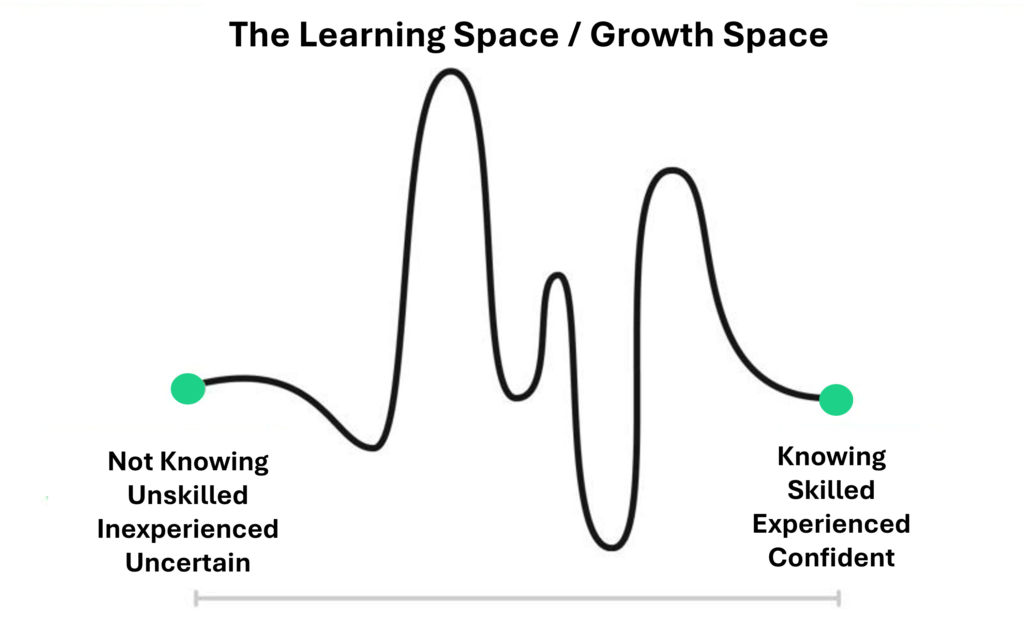
One of the most powerful ideas I’ve encountered recently comes from Dr. Becky Kennedy of Good Inside. She describes what she calls the “learning space” the gap between not knowing and knowing. It is the space between being unskilled and skilled, inexperienced and experienced, uncertain and confident.
As I reflected on that idea, I realized it perfectly describes what many of us experience in our careers and leadership journeys. The challenge is that the learning space doesn’t feel good. In fact, it often feels frustrating.
Most of us assume that resilience is a positive experience. We admire resilient people. We aspire to be resilient ourselves. But resilience rarely feels good while we’re experiencing it. Learning doesn’t feel good. Growth doesn’t feel good. Change doesn’t feel good. At least not in the moment.
The emotion most commonly associated with learning is often frustration. And for high-performing, high-potential professionals, that frustration can be especially difficult. Many of us build our careers by being knowledgeable. We became subject matter experts. We learned our systems, our industries, our customers, and our organizations. People came to us because we knew things.
Then something changes.
We get promoted.
We are asked to lead.
We are given responsibility for strategy instead of execution. We are asked to influence people we don’t directly manage. We are expected to navigate ambiguity where there are no obvious answers.
Suddenly, we spend more time in situations where we don’t know. And that can be uncomfortable. Too often, we interpret that discomfort as evidence that something is wrong.
Maybe I’m not ready.
Maybe I’m not qualified.
Maybe I’m not good at this.
But what if frustration isn’t evidence of failure? What if frustration is evidence that you’re learning? Or what if frustration is pointing to an area where growth is needed?
I’ve noticed that the frustrations that linger the longest in my own life are often connected to something I haven’t fully addressed. A conversation I’ve been avoiding. A skill I haven’t developed. A decision I’ve delayed. A mindset I need to challenge. The frustration keeps returning because the lesson keeps returning.
In that sense, frustration can serve as a signal. It may be telling us that we’re learning something new. Or it may be pointing us toward something we need to learn if we want to move forward.
Rather than asking, “How do I make this frustration go away?” a better question might be: “What is this frustration trying to teach me?”
Sometimes the answer is resilience.
Sometimes it’s a new skill.
Sometimes it’s a difficult conversation.
Sometimes it’s a change in perspective.
But often, our recurring frustrations are pointing us toward the next step in our growth.
The Hidden Challenge of Leadership Growth
One of the greatest leadership transitions is moving from being valued for what you know to being valued for how you think, how you lead, and how you help others succeed. Technical expertise matters. Functional expertise matters. Industry knowledge matters.
But leadership requires developing an entirely new set of capabilities:
- Strategic thinking
- Executive communication
- Leading change
- Influencing without authority
- Navigating conflict
- Building relationships
- Developing others
None of these skills are learned overnight. Each requires time spent in the learning space. And every one of them comes with moments of uncertainty, frustration, and discomfort.
The leaders who grow the most are not necessarily the smartest people in the room. They are often the people most willing to remain in the learning space longer than others.
Choosing Growth Instead of Comfort
Our natural instinct is to escape frustration as quickly as possible.
We want certainty.
We want competence.
We want answers.
We want to get from “not knowing” to “knowing” as fast as we can.
But growth doesn’t happen by avoiding the learning space. Growth happens by staying in it.
Here are a few ways we can intentionally choose growth over comfort:
- Volunteer Before You Feel Ready
Many of the best growth opportunities arrive before we feel prepared for them.
A new project.
A leadership role.
A presentation.
A stretch assignment.
If you wait until you feel completely ready, you may miss the opportunity that would have helped you grow.
- Seek Feedback Instead of Validation
Validation feels good.
Feedback often doesn’t.
Yet feedback is one of the fastest ways to identify opportunities for growth. The most effective leaders actively seek perspectives that challenge their assumptions rather than simply reinforce them.
- Surround Yourself with People Who Stretch Your Thinking
Growth accelerates when we spend time with people who have different experiences, different expertise, and different perspectives.
This is one reason why community matters so much. A strong professional community doesn’t simply provide support. It provides challenge. It introduces new ideas, different approaches, and questions we may not have considered on our own.
- Practice Skills Before You Need Them
Many professionals wait until they receive a promotion to begin developing leadership skills.
The better approach is to develop those skills before the opportunity arrives. Investing in communication, strategic thinking, relationship building, and leadership today creates options tomorrow.
- Become Curious About Your Frustrations
The next time you find yourself frustrated, resist the urge to immediately eliminate the feeling.
Instead, become curious.
Ask yourself:
- What am I learning right now?
- What might I need to learn?
- Is there a conversation I’ve been avoiding?
- Is there a skill gap I need to address?
- Is there a challenge that I’ve been postponing?
Frustration is not always a sign that something is wrong.
Sometimes it’s a sign that growth is happening.
And sometimes it’s an invitation to grow.
Reflection
Take a moment to consider:
- Where are you currently experiencing frustration?
- Could that frustration actually be evidence that you are learning?
- Is there a recurring frustration in your life or leadership that may be pointing to something you need to learn or a skill to be developed?
- Have you been interpreting discomfort as a signal to stop when it may actually be a signal that growth is occurring?
- What challenge have you been postponing because you don’t yet feel ready?
- What might be possible if you chose growth over comfort in that area?
The next step in your leadership journey may not require more certainty.
It may simply require the willingness to stay in the learning space a little longer—and the curiosity to ask what it might be trying to teach you.