The JDE Connection: Episode 121 – Ope, I Still Need to Customize. Now What?
-
Posted by Quest Editor
- Last updated 9/14/26
- Share
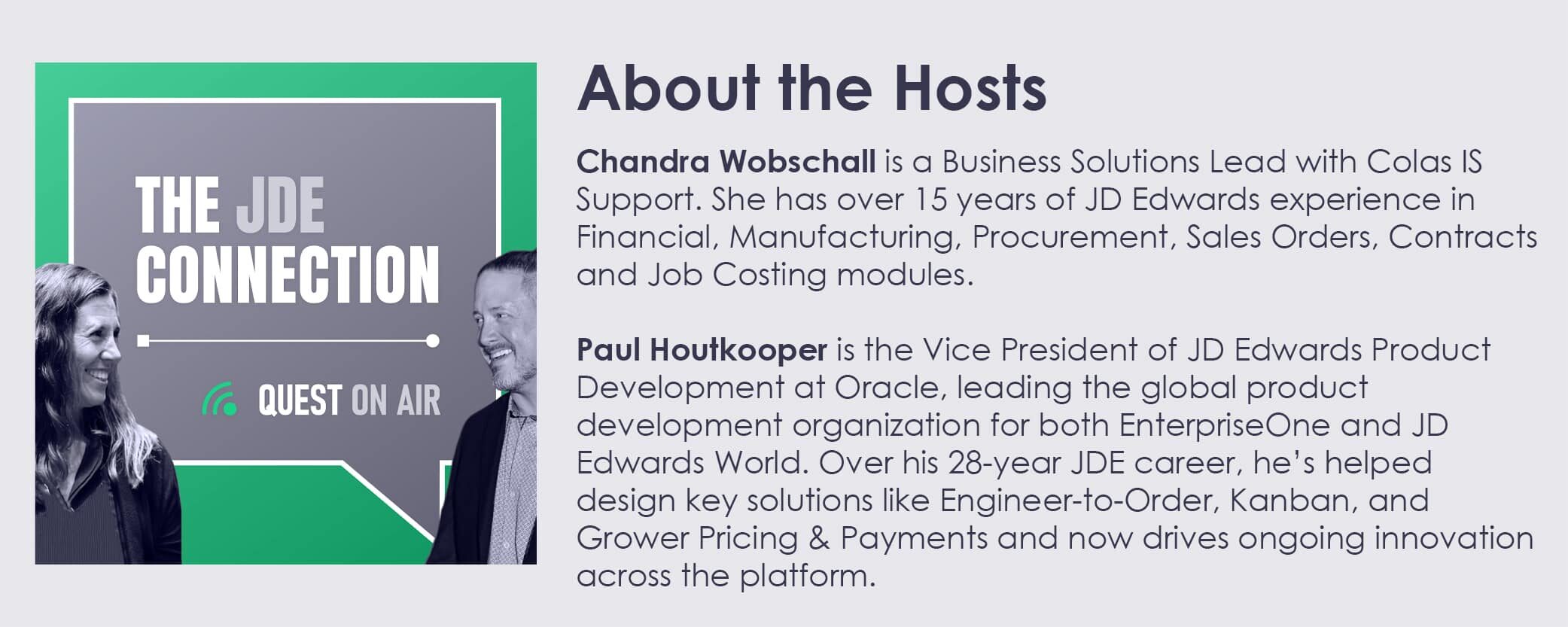
Hosted by Chandra Wobschall and Paul Houtkooper

Hey JDE Connection listeners, Chandra and Paul here! This week we tackled a word that can make some people in the JD Edwards world twitch a little: customization.
We spend plenty of time talking about modernization, extensibility, and all the tools available today that can help us reduce customizations. And we should. But as we talked, we kept coming back to a simple reality. Sometimes the business still needs something the standard software and extensibility tools cannot quite provide.
So, if customization is still part of our world, how do we live with it without making our future selves miserable? And yes, Paul has apparently accumulated some scar tissue on this subject. Possibly enough to require counseling. That seemed like a good indication that we should talk about it.
You Clone It, You Own It
We started with what seemed like an obvious question: Should we just modify all the base objects?
Sure. What could possibly go wrong? Paul has seen enough over the years to answer that question from experience, including customizations carried forward from much older releases and the interesting conversations that followed when things didn’t work quite as expected.
One phrase from our conversation summed up the alternative nicely: you clone it, you own it.
There is still responsibility involved. ESUs happen. Changes happen. Retrofitting happens. But keeping our changes separate gives us a much better chance of knowing what belongs to us and what belongs to the standard product. That distinction becomes awfully important when something goes sideways.
The Little Things Aren’t So Little
This conversation was a good reminder that seemingly small development decisions can have consequences well beyond the moment we’re making them. Naming conventions, system codes, where we hook in custom logic, and how we interact with standard tables all matter.
The same goes for indexes. Chandra had one of those “wait, have I ever actually asked that question?” moments when we talked about modifying an existing index versus creating our own. A change that looks perfectly reasonable for one use case may affect many other places where that same index is being used.
Someday, Someone Has to Support This
Performance became another big part of our conversation, and this is where Paul’s history of being put on a plane to help troubleshoot customer issues came into play.
Customization itself wasn’t always the problem. Sometimes the trouble came from custom code that didn’t follow the same basic performance practices we’d expect from standard development. Worse, when the base object had been modified, it wasn’t always obvious where the performance issue originated.
Midwesternism of the Day
This week’s Midwesternism came courtesy of an entertaining video sent by one of Paul’s friends. Our mystery word is something many of us grew up asking someone to hand us from across the living room. It helped us control our evening entertainment, although Paul remembers a time when changing the channel required a little more physical effort. And apparently some creative household engineering involving pliers. If any of that sounds familiar, this one may immediately transport you back a few decades.
Until next time, let’s keep learning, sharing, and most importantly, laughing together.
Toodles!

Missed an episode? Check out the full episode list! Also, be sure to subscribe on your favorite podcast provider, or select a provider below!
 |  |  |  |
Learn More
Quest Oracle Community is where you learn. Ask questions, find answers, swap stories and connect to other JD Edwards customers and product experts in the JD Edwards Community, where you can also check out what’s happening in the Business Analyst SIG.