The JDE Connection: Episode 93 – Intro to IIBA and BABOK with Nathan Diamond
-
Posted by Quest Editor
- Last updated 1/27/26
- Share
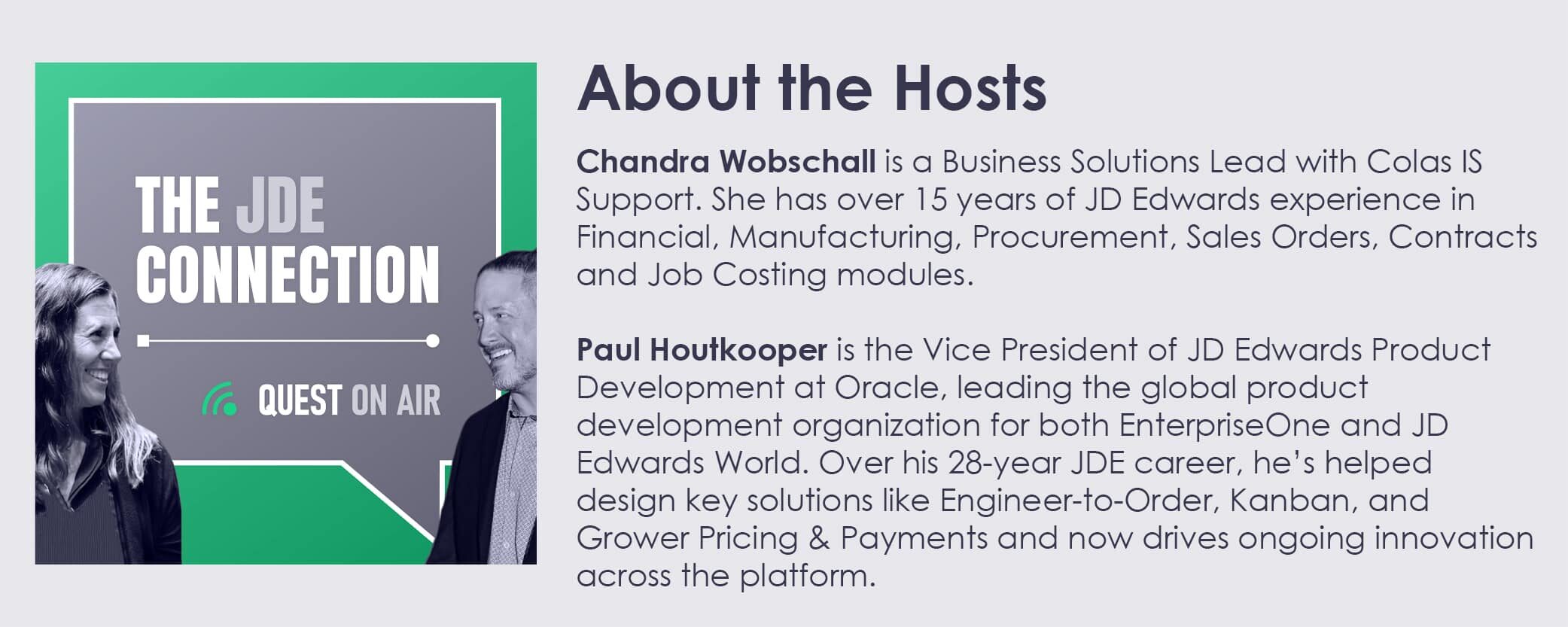
Hosted by Chandra Wobschall and Paul Houtkooper
Hey JDE Connection listeners, Chandra and Paul here! This episode came from a place of genuine curiosity. Over the years, we’ve talked a lot about what Business Analysts do in the JD Edwards world, but not always about how they learn to do it well, or how they sharpen their craft over time.
So, we were excited to sit down with Nathan Diamond from Ajinomoto Foods North America to talk about the International Institute of Business Analysis (IIBA) and the BABOK, the Business Analysis Body of Knowledge, and what role they can play in developing strong, confident BAs
Not a Straight-Line Career Path
Nathan’s journey into business analysis didn’t start in the business at all. He came from an IT infrastructure background, servers, networking, and the world of ones and zeros, before moving into a BA role. What made that transition work wasn’t a title change. It was curiosity. Nathan talked about sitting next to people in procurement, inventory, and manufacturing, watching how they worked, and asking questions. That willingness to learn, combined with technical instincts, eventually made tools like Orchestrator a natural fit.
It was a great reminder that there’s no single “right” path into business analysis. What matters more is how willing you are to learn the business and build trust along the way.
What Makes a Good Business Analyst?
One of the most interesting parts of the conversation was Nathan’s take on what really defines a good BA.
Yes, you need some technical understanding.
Yes, you need business knowledge.
But just as important are the human skills: communication, approachability, and the ability to build relationships. As we talked it through, it became clear that many people in the JDE ecosystem carry the “BA” title simply because they’re not developers. But business analysis is a discipline in its own right, with techniques, frameworks, and practices that go far beyond being the go-between for IT and the business. That’s where IIBA and the BABOK come in.
What Is BABOK (and Why It’s Not a Cover-to-Cover Read)?
Nathan explained that the BABOK isn’t a step-by-step manual you read from page one to the end. It’s a reference framework, one that covers everything from strategy and elicitation to requirements, solution evaluation, and stakeholder engagement. One key insight stood out: Most real-world work doesn’t start at “Chapter 1.”
Instead, you find yourself somewhere in the middle trying to understand the current state, define a future state, assess risk, or explain why a change is needed in the first place. BABOK helps give structure and language to those moments, no matter where you’re starting.
And importantly, you don’t need to pursue a certification to benefit from it. Many people use the BABOK simply as a toolkit, something to pull from when challenges come up.
Certifications: Picking the Right Fit
We also talked through the different IIBA certification paths—from entry-level options to more advanced certifications—and why Nathan chose the one that best aligned with his role in the JDE world.
The takeaway wasn’t “everyone should get certified.” It was that intentional learning matters. Whether that’s through a certification, a book, a mentor, or hands-on experience, investing in how you approach business analysis pays off over time.
The Cost of Skipping the “Why”
A big theme in this episode was documentation, or, more specifically, what happens when it’s missing.
We’ve all seen it:
- Requirements captured verbally (or not at all)
- Decisions made without context
- Enhancements delivered with no record of why they exist
Nathan, Chandra, and Paul all shared examples where the lack of documented intent led to rework, scope creep, or painful rediscovery years later. Without the “why,” it’s nearly impossible to evaluate success—or even know whether something should be changed at all. Good business analysis isn’t about slowing things down. It’s about preventing churn, preserving institutional knowledge, and giving future teams the context they’ll desperately wish they had.
Finding the Balance
Of course, we also acknowledged reality. Teams are busy. Resources are constrained. Nobody wants to create unnecessary overhead. The goal isn’t rigid process, it’s thoughtful discipline. Enough structure to capture intent and requirements clearly, without forcing every initiative through a heavyweight framework that doesn’t fit. Finding that balance is hard, but it’s also where strong BAs make the biggest difference.
A Familiar Reminder to Wrap Things Up
We closed the episode with a gentle reminder—one that applies just as much to business analysis as it does to life: if you don’t slow down enough to capture what matters, you’ll end up retracing your steps later, wondering why things were done the way they were. Sometimes the long way around turns out to be the fastest path after all.
Until next time, let’s keep learning, sharing, and laughing together.
Toodles!

Missed an episode? Check out the full episode list! Also, be sure to subscribe on your favorite podcast provider, or select a provider below!
 |  |  |  |
Learn More
Quest Oracle Community is where you learn. Ask questions, find answers, swap stories and connect to other JD Edwards customers and product experts in the JD Edwards Community, where you can also check out what’s happening in the Business Analyst SIG.